A diagnosis of endometriosis often brings one immediate fear:
“Will I be able to get pregnant?”
The answer is not the same for every woman.
Some women with endometriosis conceive naturally without much difficulty. Others may take longer, while some may need fertility treatment depending on their age, ovarian reserve, fallopian tubes, severity of endometriosis and other fertility factors.
So, having endometriosis does not automatically mean infertility.
At the same time, if pregnancy is your goal, endometriosis is something that should be understood properly rather than ignored.
Ayurveda can also be considered as part of a broader fertility-care approach, particularly for menstrual health, digestion, lifestyle, stress, pain and overall reproductive wellbeing.
What Exactly Is Endometriosis?
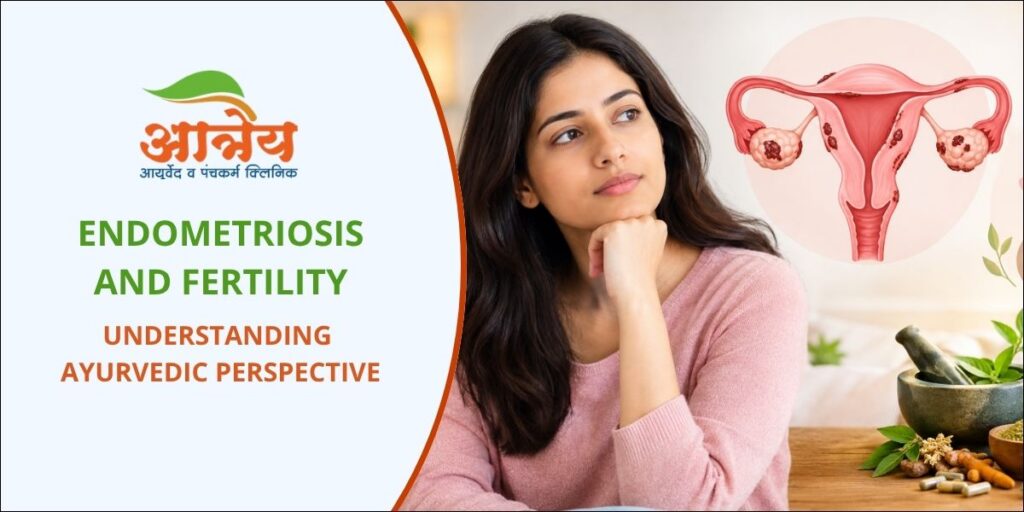
Endometriosis is a condition in which tissue similar to the lining of the uterus is present outside the uterus.
It may involve areas such as:
- ovaries
- fallopian tubes
- pelvic lining
- tissues around the uterus
- other pelvic structures
These areas can respond to hormonal changes during the menstrual cycle and may be associated with inflammation, pain, adhesions or ovarian cysts called endometriomas.
Some women experience severe symptoms. Others may have relatively mild symptoms and discover endometriosis only during fertility evaluation.
The Symptoms Are Not Always the Same
One woman may experience severe period pain. Another may mainly complain of pain during intercourse. A third may have very little pain but difficulty conceiving.
Common symptoms can include:
- painful periods
- chronic pelvic pain
- lower back or pelvic discomfort
- pain during or after intercourse
- painful bowel movements during periods
- urinary discomfort around menstruation
- bloating
- heavy or irregular bleeding
- fatigue
- difficulty becoming pregnant
The intensity of pain does not always tell us how extensive the endometriosis is. That is why symptoms alone should not be used to judge the severity of the condition.
How Can Endometriosis Affect Fertility?
This is where many women become anxious. Endometriosis may affect fertility through more than one mechanism.
1. Inflammation in the Pelvic Environment
Endometriosis is associated with inflammatory changes within the pelvis. This altered environment may interfere with several steps involved in reproduction. It does not necessarily prevent pregnancy, but in some women it may make conception more difficult.
2. Adhesions Can Affect the Tubes and Ovaries
Repeated inflammation may sometimes lead to scar tissue or adhesions. If this alters the normal relationship between the ovary and fallopian tube, egg pickup and transport may be affected.
3. Endometriomas Can Involve the Ovaries
When endometriosis forms a cyst within an ovary, it is called an endometrioma. Ovarian involvement becomes particularly relevant when assessing fertility because ovarian reserve and previous ovarian surgery may need to be considered carefully.
4. Fertility Is Never About Endometriosis Alone
This is an important point. If a woman with endometriosis is trying to conceive, we should not assume that endometriosis is the only fertility factor.
We also need to consider:
- woman’s age
- ovulation
- ovarian reserve
- fallopian tube status
- uterine factors
- menstrual pattern
- semen analysis of the male partner
- duration of infertility
- previous surgeries
- previous fertility treatment
A fertility plan should therefore look at the couple as a whole.
How Does Ayurveda Understand Endometriosis?
Ayurveda does not have a single classical disease name that exactly corresponds to the modern diagnosis of endometriosis. So it would not be correct to say:
“Endometriosis is exactly this one Ayurvedic disease.” Instead, an Ayurvedic physician looks at the pattern of symptoms and dysfunction in that individual woman.
For example:
- Is menstruation extremely painful?
- Is the pain cramping, pulling or stabbing?
- Is there heavy bleeding?
- Are clots present?
- Is bowel movement painful during periods?
- Is there bloating or constipation?
- Are cycles regular?
- Is there pelvic heaviness?
- How is digestion?
- How is sleep and stress?
- Is fertility also affected?
These details help form the Ayurvedic understanding of the case.
The Role of Apana Vata
In Ayurveda, Apana Vata is closely related to functions occurring in the pelvic region, including menstruation and reproductive processes. When its normal direction and function are disturbed, menstrual and pelvic symptoms may occur.
This is one reason Vata receives considerable attention in women with painful menstruation and pelvic discomfort. But endometriosis should not simply be reduced to:
“Vata has increased.”
Depending on the presentation, Rakta, Pitta, Kapha, digestion and other factors may also need consideration.
Why Pain Is Important in Ayurvedic Assessment
Pain itself gives useful clinical information. A woman who experiences intense spasmodic pain with constipation and bloating may not be approached in exactly the same way as another woman who has heavy bleeding, burning sensation and marked pelvic inflammation.
Ayurvedic treatment is therefore ideally symptom-pattern based and individualized, rather than giving the same medicines or Panchakarma to every woman diagnosed with endometriosis.
Endometriosis and Fertility: What Should the Treatment Goal Be?
When fertility is involved, treatment goals need to be practical.
The aim should not simply be:
“We must remove endometriosis.”
Instead, the broader fertility plan may need to focus on:
- managing menstrual and pelvic symptoms
- supporting regular ovulation where relevant
- maintaining appropriate nutrition
- supporting digestive health
- avoiding unnecessary delay in conception attempts
- reducing factors that worsen pain or bowel symptoms
- considering ovarian reserve and age
- coordinating appropriately with gynecological or fertility treatment when required
This is where individualized care becomes particularly important.
Can Ayurveda Help Women With Endometriosis Who Are Trying to Conceive?
Ayurvedic treatment may be considered as part of an individualized fertility plan.
The approach may include:
- correction of diet and digestion
- improvement of bowel regularity
- menstrual-cycle assessment
- stress and sleep management
- suitable Ayurvedic medicines
- selected Panchakarma therapies where indicated
- preparation before conception
- support during appropriate phases of fertility planning
What should be avoided is promising every woman that Ayurveda will “cure endometriosis” or that pregnancy is guaranteed. Fertility depends on too many factors for such claims to be responsible.
Does Every Woman With Endometriosis Need Panchakarma?
No.
This is an area where treatment often becomes unnecessarily standardized. Endometriosis does not automatically mean:
“Do Virechana.”
Nor does infertility automatically mean:
“Do Basti or Uttarbasti.”
Panchakarma selection depends on:
- symptoms
- age
- strength
- digestion
- menstrual pattern
- disease stage
- ovarian reserve
- whether pregnancy is currently being attempted
- whether IVF or another fertility treatment is planned
- associated medical conditions
In some women, Panchakarma may form part of treatment. In others, diet, medicines, lifestyle and fertility timing may be more important.
What About Basti?
Basti has an important place in Ayurveda, particularly in Vata-dominant conditions.
Because pelvic function and reproductive physiology are closely connected with Apana Vata in Ayurvedic understanding, selected Basti protocols may be considered in some fertility patients.
But the formulation, duration and timing should be individualized. It should not be offered as the same package to every woman with endometriosis.
What About Uttarbasti?
Women researching Ayurvedic fertility treatments often come across Uttarbasti. This procedure has specific Ayurvedic indications and should only be considered after proper evaluation.
It is not automatically required for every woman with endometriosis or infertility, and its timing and suitability need careful clinical decision-making.
Especially when a woman has active infection, significant pelvic pathology, is undergoing fertility treatment or pregnancy is possible, appropriate precautions are essential.
Diet in Endometriosis: Do You Need a Very Restrictive Diet?
Usually, extreme restrictions are not the best starting point. Women often arrive at the clinic having already removed:
gluten, dairy, rice, pulses, fruits and several other foods after reading different recommendations online. Eventually, the diet becomes so restricted that nutrition itself suffers.
A better approach is to look at:
- digestion
- bowel pattern
- individual food triggers
- protein intake
- iron and overall nutrition
- body weight
- meal timings
- symptoms around menstruation
Freshly prepared, balanced meals are usually a more sustainable foundation than repeated “detox diets.”
Constipation and Bloating Should Not Be Ignored
Many women with endometriosis also report:
- bloating
- painful bowel movements
- constipation
- abdominal heaviness
- digestive discomfort around menstruation
These symptoms deserve attention rather than being dismissed as unrelated. From an Ayurvedic perspective, keeping digestion and bowel movement comfortable can be an important part of overall treatment planning.
Exercise: Rest or Stay Active?
During severe pain, rest may obviously be needed. But outside painful episodes, complete physical inactivity is generally not the goal. According to individual tolerance, women may benefit from activities such as:
- walking
- gentle yoga
- mobility work
- light strength training
- breathing exercises
Exercise should not become another source of stress. The right amount is the amount that supports health without repeatedly aggravating symptoms.
Stress Matters—but Endometriosis Is Not “Because of Stress”
This distinction is very important. Women with endometriosis are sometimes told:
“You are too stressed. Just relax and you will conceive.”
That is neither fair nor medically appropriate. Stress does not adequately explain endometriosis. However, chronic pain, repeated negative pregnancy tests, fertility treatment and uncertainty around conception can themselves create considerable emotional stress.
Managing that stress may help improve:
- sleep
- appetite
- emotional wellbeing
- treatment adherence
- overall quality of life
Yoga, Pranayama, meditation, counselling or other forms of emotional support may therefore be useful as part of comprehensive care.
When Should Fertility Evaluation Not Be Delayed?
If a woman already knows she has endometriosis and wants to conceive, it may not be wise to simply “keep trying for years” without knowing the complete fertility picture.
Earlier assessment becomes particularly relevant when:
- age is increasing
- ovarian endometrioma is present
- previous ovarian surgery has been performed
- cycles are irregular
- ovarian reserve is a concern
- pregnancy has not occurred despite regular attempts
- there is a history of pelvic surgery
- severe endometriosis has already been diagnosed
The purpose of evaluation is not automatically to move toward IVF. It is to understand how much time and what options are realistically available.
Natural Conception or IVF—How Should Women Think About It?
There is no single answer. Some women with endometriosis conceive naturally. Others may benefit from fertility treatment. The decision depends on the complete picture—not merely the word “endometriosis” on a report. A younger woman with good ovarian reserve, patent tubes, regular ovulation and a normal semen analysis may have a different plan from a woman with low ovarian reserve, bilateral endometriomas or long-standing infertility.
This is why treatment should be based on fertility factors, not fear.
A Common Mistake: Spending Too Much Time Trying to “Perfect the Body”
Women seeking natural treatment sometimes spend many months trying to:
“detox the uterus,”
“balance hormones completely,”
“remove every cyst,”
or
“prepare the body perfectly before trying.”
Meanwhile, reproductive age continues to advance.
Lifestyle improvement and Ayurvedic care can certainly be valuable.
But when fertility is the goal, time itself is an important clinical factor.
A good treatment plan should improve health without unnecessarily postponing appropriate fertility evaluation or conception attempts.
Endometriosis and Fertility Care at Aatreya Ayurved & Panchakarma Clinic, Hadapsar, Pune
At Aatreya Ayurved & Panchakarma Clinic, Hadapsar, Pune, women with endometriosis and fertility concerns are assessed beyond a single diagnosis.
The consultation may include evaluation of:
- menstrual-cycle pattern
- nature and timing of pain
- bleeding and clotting
- bowel symptoms
- digestion
- ovulation history
- ovarian reserve reports where available
- ultrasound findings
- previous endometriosis surgery
- duration of infertility
- previous IUI or IVF treatment
- sleep and stress
- partner’s fertility evaluation
Based on the complete picture, Ayurvedic medicines, diet and lifestyle guidance, and selected Panchakarma therapies may be considered where appropriate.
When gynecological investigation, surgery, fertility monitoring or assisted reproductive treatment is clinically important, these should not be unnecessarily delayed.
The aim is to build a fertility plan around the woman in front of us—not simply around the diagnosis written on her ultrasound report.
Final Thoughts
Endometriosis can make conception more challenging for some women, but it does not close the door to pregnancy. The most useful approach is neither to panic after diagnosis nor to ignore it.
Understand:
- your age
- your ovarian reserve
- your tubes
- your ovulation
- your partner’s fertility
- your endometriosis and
- your reproductive goals.
Ayurveda can contribute through individualized attention to menstrual health, digestion, bowel function, lifestyle, nutrition, stress, strength and suitable therapies.
But good fertility care also means knowing when investigations, gynecological treatment or assisted reproduction should be considered. The goal should never be to prove that one system of medicine is enough.
The goal is to give the woman the best possible opportunity for a healthy conception while protecting her long-term reproductive health.
FAQs
Does endometriosis always cause infertility?
No. Many women with endometriosis conceive naturally. Fertility varies according to age, severity of disease, ovarian reserve, tube health and other fertility factors.
Can Ayurveda cure endometriosis completely?
It would not be appropriate to guarantee that Ayurvedic treatment will completely remove endometriosis. Ayurvedic management may be used to address the individual’s menstrual, digestive, lifestyle and fertility-related concerns and may form part of a broader treatment plan.
Can I conceive naturally if I have an endometrioma?
Natural conception may still be possible in some women. The size and location of the endometrioma, ovarian reserve, age, tube status and other fertility factors need to be considered.
Does every woman with endometriosis need surgery?
No. Surgery is not automatically required in every case. The decision depends on symptoms, cyst characteristics, fertility goals, ovarian reserve and specialist assessment.
Is Panchakarma compulsory for endometriosis?
No. Panchakarma should be recommended only when it is appropriate for that particular woman. Every endometriosis patient does not need the same Panchakarma protocol.
Is Basti useful in endometriosis-related infertility?
Basti may be considered in selected patients as part of an Ayurvedic treatment plan, particularly where Vata-related features are clinically relevant. Its type, timing and duration should be individualized.
Is Uttarbasti necessary for every case of endometriosis?
No. Uttarbasti is a specialized Ayurvedic procedure with specific indications. It should not be routinely advised to every woman with endometriosis or infertility.
Should I avoid dairy or gluten if I have endometriosis?
Not necessarily. There is no reason for every woman to eliminate multiple food groups automatically. Individual tolerance, nutrition, digestive symptoms and medical requirements should guide dietary changes.
Can stress cause endometriosis?
Endometriosis should not be explained simply as a result of stress. However, chronic pain and fertility difficulties can create significant emotional stress, so stress management remains an important part of overall care.
When should I consult for fertility if I already have endometriosis?
If you know you have endometriosis and pregnancy is a current goal, discussing fertility earlier can be useful—particularly if you are older, have ovarian endometriomas, previous ovarian surgery, irregular cycles, concerns about ovarian reserve or have already been trying unsuccessfully.
Where can I get Ayurvedic treatment for endometriosis and infertility in Pune?
Aatreya Ayurved & Panchakarma Clinic, Hadapsar, Pune provides individualized Ayurvedic consultation for women with endometriosis, menstrual problems and fertility concerns, with treatment planning based on symptoms, reproductive history, investigations and overall health.