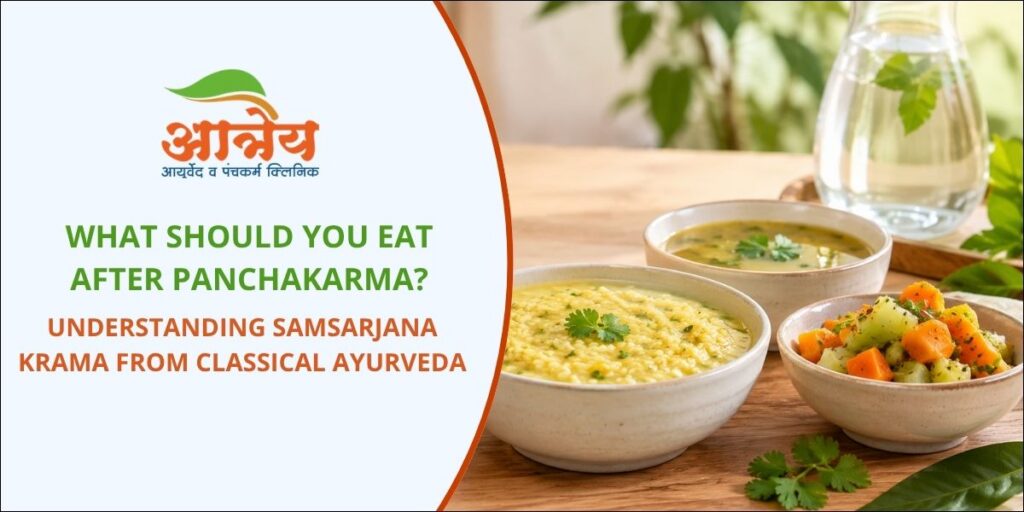
In Ayurveda, Panchakarma does not end when the main procedure is completed. In fact, what a patient does after Shodhana is considered an important part of the treatment itself. A person may complete Vamana or Virechana properly, but if immediately afterwards he returns to heavy food, fried food, restaurant meals, excessive eating or an irregular routine, the purpose of the carefully performed Shodhana may be compromised. This is why the Ayurvedic classics describe a specific post-Shodhana dietary protocol called Samsarjana Krama (संसर्जन क्रम)
It is not simply a “light diet after detox.” It is a systematic method of gradually restoring Jatharagni—the digestive capacity—after purification. First, an Important Clarification:
Does Every Panchakarma Need the Same Diet?
No.
The term “post-Panchakarma diet” is commonly used today, but classical Ayurveda is more specific. The detailed Peyadi Samsarjana Krama is particularly important after major Shodhana procedures such as Vamana and Virechana.
Dietary instructions after Basti, Nasya, Raktamokshana or other procedures may differ according to the treatment, disease, Dosha, Agni and strength of the patient.
Therefore, there is no single “Panchakarma diet chart” that should be given to everyone.
The post-treatment diet must be decided according to:
- Which Shodhana was performed
- Whether Shuddhi was Pravara, Madhyama or Avara
- Agni of the patient
- Bala of the patient
- Prakriti and Vikriti
- Disease condition
- Age and season
- Clinical response after Shodhana
This individualized approach is central to classical Ayurveda.
Why Is Agni So Important After Shodhana?
Ayurveda considers Agni fundamental to digestion, nourishment and maintenance of health. After proper Vamana or Virechana, Doshas have been expelled from the body, but the digestive strength may temporarily become delicate. Therefore, the patient is not immediately given the usual Guru Ahara. Vagbhata explains this beautifully in Ashtanga Hridaya, Sutrasthana 18. He compares the patient’s Agni after Shodhana to a small flame.
A tiny fire cannot immediately burn a large log. First, it is gradually nourished with light combustible material. As it grows, it becomes stable and capable of burning heavier material. In the same way, after Shodhana, Peya and subsequent foods are introduced step by step until Agni becomes Mahat, Sthira and Sarvapacha—strong, stable and capable of digesting the normal diet. This analogy is given in Ashtanga Hridaya Sutrasthana 18/30.
This is the real Ayurvedic reasoning behind Samsarjana Krama. It is not primarily about calories. It is about Agni Sandhukshana—gradual rekindling of digestive strength.
What Is Samsarjana Krama?
Samsarjana Krama is a sequential dietary regimen given after Shodhana. Both Charaka and Vagbhata describe a progression broadly consisting of:
Peya → Vilepi → Akruta Yusha → Kruta Yusha → Akruta Mamsa Rasa → Kruta Mamsa Rasa → Normal Ahara
Charaka discusses this sequence in Siddhi Sthana, Kalpana Siddhi Adhyaya, while Vagbhata describes it in Ashtanga Hridaya, Sutrasthana 18/28–30.
Notice something important here: The classical sequence is not simply— Soup → Khichdi → Normal food. There is a deliberate progression from Laghu and simpler preparations towards progressively more nourishing and heavier foods.
Stage 1: Peya
Peya is a thin rice preparation containing a greater proportion of liquid with a small quantity of well-cooked rice particles.
It is lighter than Vilepi. After appropriate Shodhana, Peya is used when Agni is still in the early stage of recovery. Classical Ayurveda describes Peya as Laghu and useful for supporting digestion and Vatanulomana. This is why the first meal after major purification is deliberately kept very light. The purpose is not to “fill the stomach.” The purpose is to give Agni only as much work as it can comfortably handle.
Stage 2: Vilepi
Once Peya is digested properly and Agni shows increasing capacity, the next stage is Vilepi. Vilepi is thicker than Peya, with comparatively more cooked rice and less liquid. Classical descriptions attribute qualities such as:
- Laghu
- Tarpana
- Grahi
- Hridaya
- Agni-supportive action
to properly prepared Vilepi.
Thus, the progression itself demonstrates an important Ayurvedic principle: As Agni increases, Ahara can gradually become more substantial.
Stage 3: Akruta Yusha
The next stage traditionally includes Yusha, generally a pulse-based soup. First comes Akruta Yusha. “Akruta” indicates a simpler preparation without the richer processing used in Kruta Yusha. At this stage, the digestive system is being exposed to food that is nutritionally more substantial than Peya or Vilepi, but the progression remains controlled.
Stage 4: Kruta Yusha
After the patient properly digests Akruta Yusha, Kruta Yusha may be introduced.
Kruta Yusha is a more processed or seasoned preparation, traditionally incorporating appropriate additions such as Sneha and Lavana according to the classical method and the physician’s judgement.
Why is plain Yusha given before the richer version? Again, the answer is Agni. Ayurveda gradually increases the Guruta and complexity of the food rather than suddenly challenging a recently weakened digestive fire.
Stage 5 and 6: Akruta and Kruta Mamsa Rasa
Classical Samsarjana Krama further describes:
Akruta Mamsa Rasa → Kruta Mamsa Rasa
Mamsa Rasa is meat broth.
This is important to mention because many modern “Ayurvedic detox diets” completely remove this stage from the classical description and replace the entire sequence with khichdi. That may be convenient, but it is not an accurate representation of what the Granthas actually describe. Mamsa Rasa represents a further step towards Brimhana and Bala restoration as Agni becomes stronger. For vegetarian patients, or in individuals for whom Mamsa Rasa is unsuitable, the treating Ayurvedic physician may clinically adapt the diet.
However, we should distinguish between: What the classical text actually describes and how a physician appropriately modifies it for an individual patient today. That distinction is important when practising Granthokta Ayurveda.
Is Khichdi the Classical First Food After Panchakarma?
Not necessarily.
Today, “Panchakarma diet” and “moong dal khichdi” have almost become synonymous. Khichdi can certainly be useful in Ayurvedic dietary planning. But classical Peyadi Samsarjana Krama does not begin by simply giving everyone a bowl of regular khichdi immediately after Vamana or Virechana.
The classical progression begins with lighter preparations such as Peya and moves progressively according to Agnibala.
Therefore:
“Panchakarma is over—now eat khichdi for three days”
is an oversimplification of Samsarjana Krama.
Why Is Old Shali Rice Traditionally Preferred?
Classical texts frequently give importance to suitable varieties of Shali Dhanya in light dietary preparations. Vagbhata specifically refers to Raktashali when describing the dietary progression after Shodhana.
The principle is to choose food that is:
- Pathya
- Relatively Laghu
- Properly cooked
- Suitable to the condition of Agni
- Freshly prepared
rather than highly processed or complicated meals. The emphasis is not on making the meal fashionable. It is on making the food compatible with the current strength of Agni.
How Long Should Samsarjana Krama Be Followed?
Here again, classical Ayurveda does not give the same schedule to everyone. The duration depends particularly on the degree of Shuddhi obtained. Traditionally, Shuddhi is assessed as:
- Pravara Shuddhi : More complete or superior purification.
- Madhyama Shuddhi : Moderate purification.
- Avara or Hina Shuddhi : Lesser degree of purification.
The sequence of Peya, Vilepi, Yusha and Rasa is repeated for different numbers of Annakala—meal times—depending upon the degree of Shuddhi. Charaka and Vagbhata both describe this graded approach. This is extremely important clinically. The duration of Samsarjana Krama should therefore not be decided simply as:
“Everyone follows a 3-day diet.”
The physician must assess the Shuddhi and Agni before deciding progression.
How Does the Vaidya Know When to Progress the Diet?
A classical Ayurvedic physician does not progress the diet only because a certain number of hours have passed. The patient is assessed for the response of Agni.
Important practical observations include:
- Proper hunger
- Absence of heaviness
- Comfortable digestion of the previous meal
- Normal movement of Vata
- Appropriate bowel response
- Absence of nausea
- Absence of excessive abdominal distension
- Feeling of Laghava
- Improvement in strength
The central question is:
Has the previous stage been digested properly?
If not, increasing the heaviness of food simply because the printed diet chart says so would go against the principle of individualized Ayurveda.
What Should Be Avoided During Samsarjana Krama?
During this phase, one should particularly avoid suddenly burdening Agni with Guru, Vidahi, Ati-Snigdha, Ati-Ruksha or otherwise inappropriate Ahara.
In practical terms, foods and habits usually restricted include:
- Heavy meals
- Deep-fried food
- Excessively oily food
- Very spicy or irritating foods
- Large quantities of sweets
- Viruddha Ahara
- Excessive eating
- Repeated snacking
- Refrigerated or stale food
- Alcohol
- Unnecessary stimulants
- Restaurant and highly processed food
But Ayurveda goes beyond simply giving a “do not eat” list.
Ahara Matra—quantity—is equally important.
Even a Pathya food can disturb digestion if taken in excess.
Bhojana Vidhi Matters as Much as the Food
Post-Shodhana care should also respect the broader Ayurvedic principles of eating.
Food should ideally be:
- Ushna – appropriately warm
- Freshly prepared
- Taken after the previous meal has digested
- Taken according to Agnibala
- Taken in appropriate quantity
- Consumed calmly and attentively
A patient cannot follow Samsarjana Krama correctly merely by choosing the right ingredients while ignoring how, when and how much food is eaten. Ayurveda treats Ahara Vidhi as part of treatment.
Is Warm Water Necessary?
Ushna Jala may be advised during the post-Shodhana period depending upon the procedure and the patient’s condition. However, even here Ayurveda does not support the modern idea that repeatedly drinking litres of hot water will “flush toxins from the body.” The purpose and quantity must be appropriate. Excessive water intake can itself interfere with digestion. Therefore, thirst, Agni, Dosha, season and the treating physician’s instructions should guide fluid intake.
What About Fruits, Salads and Smoothies?
One common modern assumption is:
I have finished Panchakarma, so now I should eat only raw fruits and salads because they are healthy.” This does not necessarily agree with the principle of Samsarjana Krama. Immediately after major Shodhana, Ayurveda gives priority to Laghu, Ushna, properly cooked and easily manageable food rather than immediately loading the digestive system with large quantities of raw food. A food may be nutritionally “healthy” yet still not be appropriate for the current state of Agni. This distinction is fundamentally Ayurvedic.
What About Milk and Dairy?
Dugdha has an important place in Ayurveda, but it is not automatically appropriate at every stage after Shodhana. Whether milk, Takra, Ghrita or another dairy preparation is indicated depends upon:
- Agni
- Dosha
- Disease
- Shuddhi
- Satmya
- Bala
- Stage of Samsarjana
Therefore, adding milk, curd, buttermilk or ghee simply because they are “Ayurvedic foods” is not correct.
Dravya must be selected according to Avastha.
Samsarjana Krama Is Not Fasting
Another misconception is that after Panchakarma the patient should “eat almost nothing.” That is not the intention. The purpose is neither starvation nor dieting. The purpose is Krama—proper sequence. The patient moves gradually from lighter to more nourishing foods as Agni recovers. In fact, the endpoint of proper Samsarjana is not prolonged restriction. The endpoint is restoration of an Agni that can once again digest the person’s appropriate normal diet.
Classical Ayurveda Also Describes More Than One Samsarjana Approach
Peyadi Samsarjana Krama is the best-known sequence, but Ayurvedic teaching also recognizes other approaches such as Tarpanadi Samsarjana and Rasa Samsarjana in appropriate situations. This again shows why a single downloadable “Panchakarma diet chart” cannot represent the entire Ayurvedic approach. The Vaidya must decide the appropriate regimen according to the patient’s condition.
The Most Important Principle: Do Not Rush Agni – If one principle from this entire article is remembered, it should be this: After Shodhana, do not judge recovery only by how hungry the patient feels. Judge whether Agni is ready. A patient may suddenly feel hungry after Virechana and think: “My stomach is completely empty. I should eat properly now.”
But the Ayurvedic approach is the opposite. The digestive fire is protected and strengthened gradually. Vagbhata’s analogy is particularly relevant here: A small flame is first nourished carefully until it becomes large, steady and capable of burning everything.
In the same way, Peya, Vilepi and subsequent foods gradually restore Antaragni after Shodhana.
Post-Panchakarma Diet at Aatreya Ayurved & Panchakarma Clinic, Hadapsar, Pune
At Aatreya Ayurved & Panchakarma Clinic, Hadapsar, Pune, post-Panchakarma diet is considered part of the therapy rather than a generic diet sheet given after treatment.
For patients undergoing Vamana or Virechana, the dietary progression is planned according to classical Ayurvedic principles such as:
- Agni Bala
- Rogi Bala
- Prakriti
- Vikriti
- Koshta
- Degree of Shuddhi
- Type of Shodhana
- Disease condition
- Satmya
The patient is guided regarding when to begin Peya, when to progress towards Vilepi and subsequent foods, and when normal Ahara can be resumed. Because proper Paschat Karma is as important as proper Pradhana Karma. Panchakarma is not complete when the procedure stops. The treatment is complete when Agni, Bala and normal dietary capacity are appropriately restored.
Conclusion
Classical Ayurveda gives a very precise answer to the question:
“What should I eat after Panchakarma?”
The answer is not simply:
“Eat khichdi.”
It is: Protect Agni. Observe Shuddhi. Follow Krama. Gradually progress from Laghu to Guru Ahara according to digestive capacity. After major Shodhana—particularly Vamana and Virechana—the classical sequence of Peya, Vilepi, Akruta and Kruta Yusha, followed by progressively more nourishing foods helps restore digestive strength in a systematic manner.
This is Samsarjana Krama. And in classical Panchakarma, it should not be viewed as an optional diet recommendation. It is an integral part of the treatment itself.
FAQs
- What is Samsarjana Krama in Ayurveda?
Samsarjana Krama is the classical gradual dietary progression followed particularly after Shodhana procedures such as Vamana and Virechana to restore Agni progressively.
- What is the first food after Virechana?
Depending upon the degree of Shuddhi and Agni, classical Peyadi Samsarjana commonly begins with preparations such as Peya, followed gradually by Vilepi and other foods under the physician’s guidance.
- Is khichdi compulsory after Panchakarma?
No. Khichdi is commonly used in present-day practice, but classical Samsarjana Krama is more detailed and begins with specific stages such as Peya and Vilepi according to Agnibala.
- What is the difference between Peya and Vilepi?
Peya is thinner and has proportionately more liquid, whereas Vilepi is thicker with more cooked grain. Vilepi is therefore introduced after the lighter Peya stage as digestive capacity improves.
- How many days should Samsarjana Krama be followed?
There is no single duration for everyone. Classical Ayurveda modifies the number of Annakala according to Pravara, Madhyama or Avara Shuddhi and the condition of Agni.
- Can I eat fruits immediately after Virechana?
Not automatically. The first priority after major Shodhana is restoration of Agni through the prescribed Samsarjana sequence. Fruits should be introduced according to the treating Vaidya’s advice.
- Can I eat normal food the day after Virechana?
Depending on the extent of Shuddhi, returning directly to a regular heavy diet may be inappropriate. The transition should follow Agni and the prescribed Samsarjana Krama.
- Is Samsarjana Krama required after every Panchakarma?
The detailed Peyadi Samsarjana Krama is especially described following major Shodhana such as Vamana and Virechana. Post-procedure care after Basti, Nasya and other therapies is individualized and may differ.
- Why is Agni weak after Shodhana?
Ayurvedic texts describe a temporary reduction in the capacity of Antaragni following purification. Therefore, progressively heavier food is introduced rather than immediately giving a regular Guru Ahara.
- Where can I get physician-supervised Panchakarma and Samsarjana Krama in Hadapsar, Pune?
Aatreya Ayurved & Panchakarma Clinic, Hadapsar, Pune provides physician-guided Panchakarma in which Purvakarma, Pradhana Karma and Paschat Karma—including individualized dietary guidance—are planned according to classical Ayurvedic principles.
Classical Ayurvedic References
Charaka Samhita – Siddhi Sthana, Kalpana Siddhi Adhyaya: describes the gradual Peya–Vilepi–Yusha–Rasa sequence according to the degree of Shuddhi.
Ashtanga Hridaya – Sutrasthana 18/28–30, Vamana-Virechana Vidhi: describes Peyadi Krama and the classical analogy of gradually kindling a small fire to restore Antaragni.
Sushruta Samhita – Chikitsa Sthana: emphasizes appropriate preparation, Shodhana and disciplined management surrounding Vamana and Virechana rather than treating them as isolated purgative procedures.